Modern silicon-carbon batteries are changing the mobile market before our eyes. For over a decade, the industry stalled at the 4500–5000 mAh mark: mobile chips advanced to 3nm, displays switched to 120 Hz LTPO, but classic lithium-ion with a graphite anode simply hit a fundamental ceiling of physical chemistry.
Today, this trend is broken: engineers have started packing 6000–6500 mAh batteries into thin bodies up to 8mm. We’ll break down the physics of the technology, the engineering pitfall of silicon expanding by 300%, and why Apple and Samsung are still waiting on the sidelines.
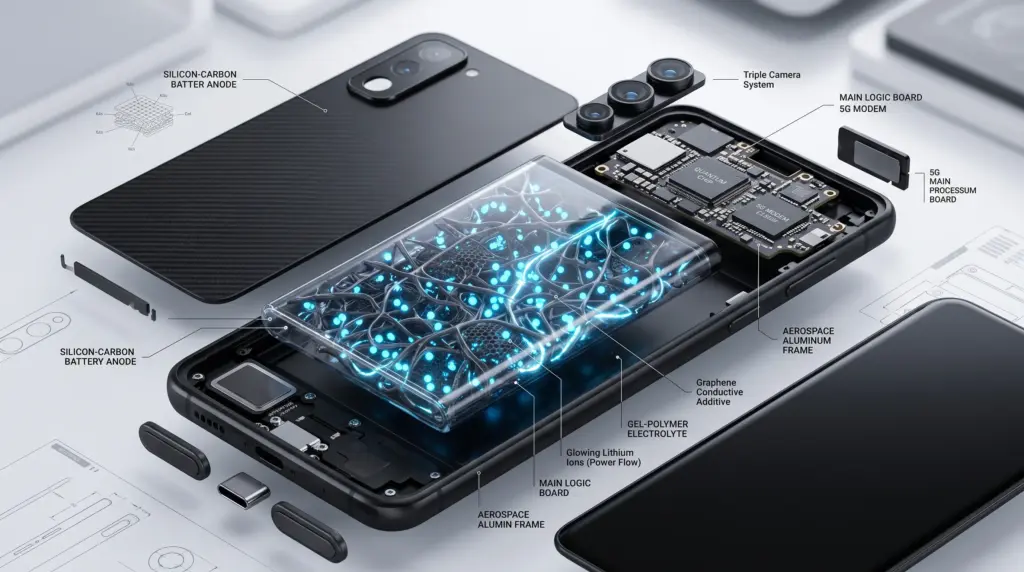
Silicon-Carbon Batteries vs. the Graphite Dead End
In a conventional lithium-ion battery, lithium ions travel from the cathode to the anode during charging. For decades, pure synthetic or natural graphite remained the ideal anode material due to its layered hexagonal structure. Lithium ions literally park between flat carbon layers—a process called intercalation.
- Theoretical capacity of graphite: ~372 mAh/g.
- Volumetric expansion during charging: less than 10%.
Graphite is reliable, withstands hundreds of cycles without crystal lattice degradation, and is maximally safe. But the lattice geometry cannot be fooled: six carbon atoms can accept exactly one lithium ion (LiC6). The lattice is packed to capacity—the capacity is exhausted. To get a 6000 mAh graphite cell, manufacturers would have to release a hefty brick an inch and a half thick.
Silicon and the 300% Catastrophe: Why Early Prototypes Failed
Silicon has always been the Holy Grail for battery developers. Unlike graphite, silicon doesn’t just allow lithium between its layers; it directly alloys with it to form an intermetallic compound (Li15Si4).
- Theoretical capacity of pure silicon: ~4200 mAh/g — more than 11 times higher than graphite.
But the laws of physics presented a harsh challenge: mechanical swelling. When accepting lithium, the volume of pure silicon increases by 300%. During discharge, it contracts back.
In a battery with a pure silicon anode, such mechanical stresses turn silicon into dust after 10–15 cycles. The passivating film (SEI – Solid Electrolyte Interphase) cracks, exposing fresh particles. The electrolyte enters a parasitic reaction, binds active lithium, and quickly dries out. The cell dies within a couple of weeks. If such a cell is packed into a hermetically sealed glass casing, the swollen battery will tear the display from its frame and break the motherboard.
Engineering Fix: Nanoporous Carbon Cages
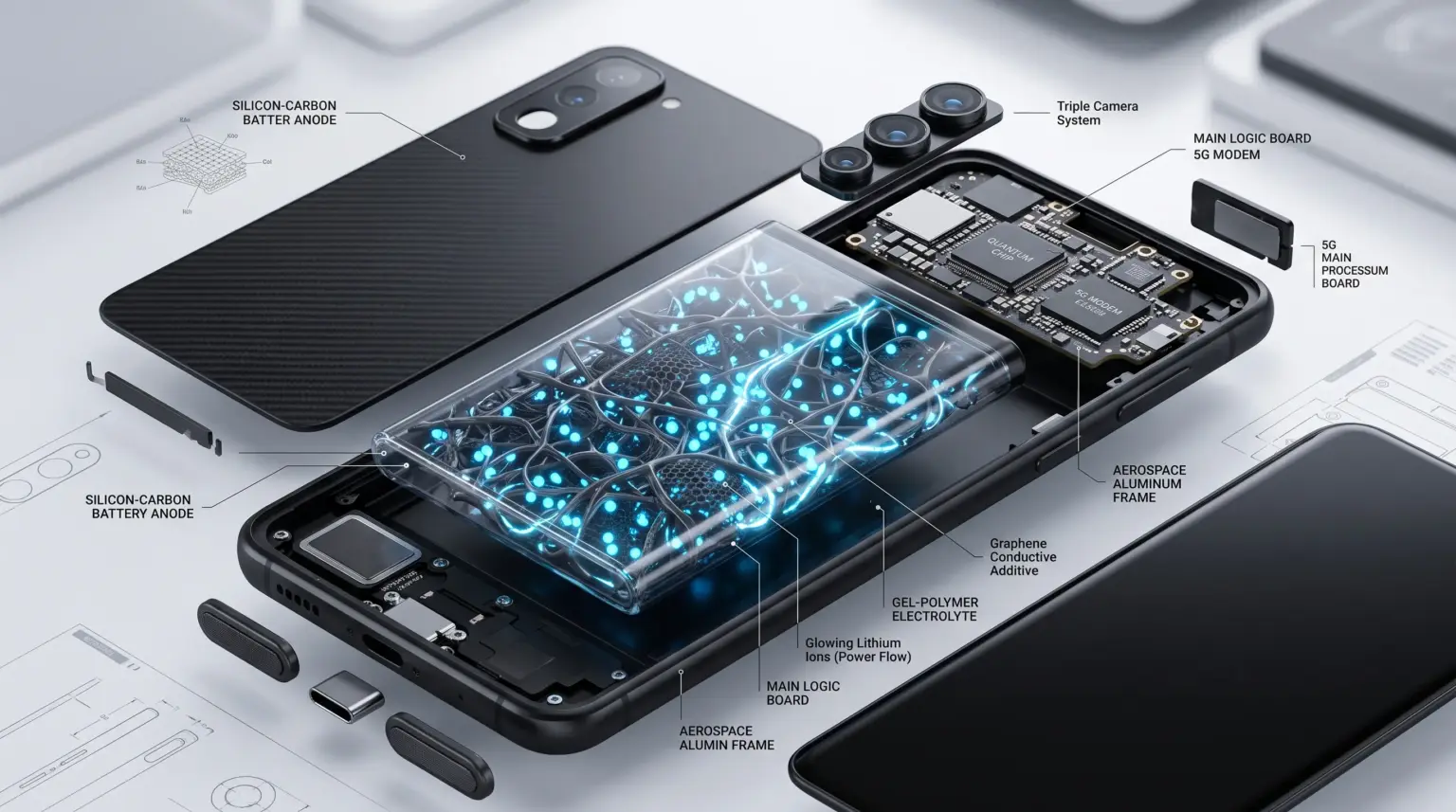
The breakthrough occurred at the intersection of materials science and nanotechnologies. Engineers abandoned solid silicon in favor of a complex nanocomposite:
- Crushing into nanoparticles: Silicon is ground into clusters smaller than 100 nm. At this scale, mechanical stress during lithium acceptance is evenly distributed and does not destroy the crystal structure.
- Carbon nanosponge: Silicon nanoparticles are packed inside a microporous carbon matrix. Carbon conducts electricity excellently and acts as a damper: silicon freely expands within the nanopore voids without changing the external geometric dimensions of the battery itself.
- Composite balance: Modern mass-produced anodes are not made of pure silicon. From 8% to 15% silicon-carbon composite is mixed into the graphite base.
Even a 10% Si/C additive increases volumetric energy density by 20–25%, surpassing the 750–800 Wh/L mark. This is why a 6000 mAh cell can now easily occupy the same physical space where an old 5000 mAh battery barely fit.
Cold Endurance: The Hidden Ace of Si/C
A pleasant side benefit of the silicon-carbon matrix is its resistance to cold. Ordinary graphite experiences a sharp voltage drop at negative temperatures: electrolyte viscosity increases, lithium diffusion slows down, and there is a risk of metallic lithium deposition (dangerous dendrites). A smartphone in the cold can unexpectedly shut down with 25–30% remaining charge.
The silicon-carbon nanostructure, combined with modified low-temperature electrolytes, maintains high ion mobility down to -20°C. The device holds its operating voltage and delivers current without emergency shutdowns.
Why Are Apple and Samsung Not Rushing into the Race?
First-tier Chinese vendors (Honor, Vivo, Xiaomi, OnePlus) are already mass-producing flagships and sub-flagships with Si/C cells. Apple and Samsung, meanwhile, maintain conservative capacities around 4000–5000 mAh using classic graphite. The reasons are purely pragmatic:
- Degradation margin over time: Early generations of Si/C lost capacity faster after 500–800 cycles. New generations guarantee 80% capacity after 1200–1600 cycles, but conservative giants demand years of telemetry from hundreds of millions of devices.
- Supply volumes: Ensuring tens of millions of stable, absolutely identical silicon cells quarterly is an extremely difficult logistical challenge.
- Thermal management during charging: Pumping 100+ W into an ultra-dense cell generates significant localized heat. To effectively dissipate heat within thin titanium frames, copper vapor chambers must be redesigned.
Silicon-carbon batteries have moved beyond the laboratory stage and become the main driver of mobile hardware autonomy. As production scales, pure graphite will eventually become a thing of the past, remaining a technology for ultra-budget feature phones.
Read other mobile hardware breakdowns on softandgadget.com.
For homelabs, remote testing, and staging environments, we run NVMe VDS instances on Erahost. Fast provisioning, European routing, and predictable I/O.
View NVMe Plans →