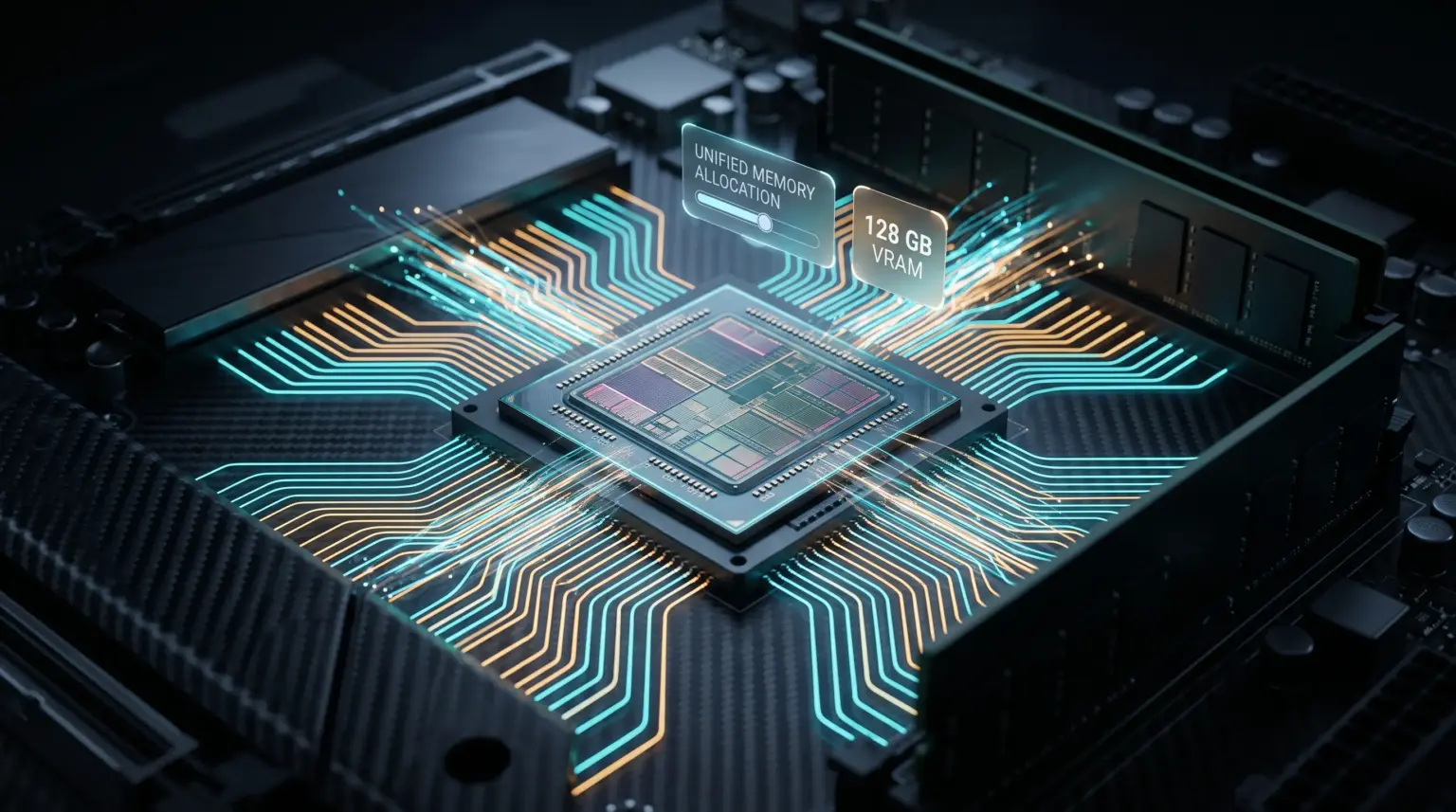
Deep within recent test builds, the concept of Windows 11 Unified Memory is becoming a reality: insiders have stumbled upon an inconspicuous but tectonic in its significance library SettingsHandlers_UnifiedMemory.dll. Hidden inside is a system mechanism codenamed IntelligentCarveout.
Microsoft is building a bridge to a unified memory architecture, following the Apple Silicon model, where the boundary between RAM and VRAM is blurred directly at the operating system scheduler level.
For anyone running local neural networks (LLMs), rendering heavy 3D scenes, or tired of artificial video memory starvation on desktops, this is a fundamental game-changer. We’re breaking down how IntelligentCarveout works, why it needs an LPDDR5X bus, and why the era of debates about “is 8 GB VRAM enough?” is coming to an end. 🧠⚡
What is IntelligentCarveout and How Windows 11 Unified Memory Works
Until now, video memory in integrated graphics processing units (iGPUs) in the Windows world operated under two inconvenient scenarios:
- Hardware Reserve (Fixed VRAM) via BIOS: The system administrator or vendor permanently carves out 2–8 GB from the RAM. This amount is visible to software as “dedicated video memory,” but if you suddenly need all the RAM for code compilation or virtualization, it’s impossible to reclaim it without a reboot.
- Dynamic Shared System Memory (via WDDM): Windows allocates memory to the iGPU on demand. This sounds good, but demanding software (PyTorch, Stable Diffusion, Ollama, or engines like Unreal Engine 5) often crashes with an Out of VRAM error because it directly requires a physically contiguous and locked Dedicated Video Memory buffer.
IntelligentCarveout directly addresses this problem: it’s a system API and a native slider in the “Settings ➔ Display ➔ Graphics” interface that allows you to dynamically, or with a soft driver restart, allocate an exclusive address pool of the required size—be it 32, 64, or even 128 GB—registering it for all graphics and compute libraries (DirectX 12, Vulkan, DirectML) as a full-fledged hardware VRAM buffer.
Comparison of iGPU Memory Management Approaches
| Parameter | Classic BIOS Carveout | Dynamic Shared WDDM | Windows 11 IntelligentCarveout |
|---|---|---|---|
| Where configured | Only in UEFI / BIOS | Automatically by OS | Directly in Windows 11 settings |
| Maximum VRAM size | Usually limited to 4–16 GB | Up to 50% of total RAM | Up to 80–90% of RAM pool (up to 128 GB+) |
| AI / LLM compatibility | Medium (limited by BIOS) | Low (frequent CUDA/ROCm crashes) | Ideal (direct exclusive pool) |
| Allocation flexibility | Zero (PC restart required) | High, but with timing losses | Adaptive (on-the-fly per task session) |
Main Beneficiary: The Onslaught of Strix Halo-Caliber APUs
Microsoft is not writing this code for old ultrabooks: the Windows 11 Unified Memory architecture is being created with a focus on an entirely new class of “heavy-duty” all-in-ones…. The emergence of SettingsHandlers_UnifiedMemory.dll is clearly synchronized with the release of a new generation of powerful all-in-ones:
- AMD Ryzen AI Max+ (Strix Halo): 16 Zen 5 cores, RDNA 3.5 graphics with 40 compute units (desktop RTX 4070 performance level), and a monstrous 256-bit LPDDR5X-8533 bus with bandwidth approaching 270 GB/s. With 128 GB of RAM installed, IntelligentCarveout will allow 96 GB of true memory to be allocated to the iGPU.
- Upcoming NVIDIA and ARM platforms: preparing the Windows ecosystem for a unified pool of high-speed memory for NPU and GPU blocks on a single die.
What This Means for System Administrators, Developers, and Gamers
- Local Neural Networks Without Server Racks: Thanks to the implementation of Windows 11 Unified Memory, running LLaMA-3 70B in Q4/Q8 quantization will now be possible on a single compact mini-PC or workstation without buying four used 24 GB RTX 3090 graphics cards. A 64–96 GB VRAM pool covers 99% of local data science tasks.
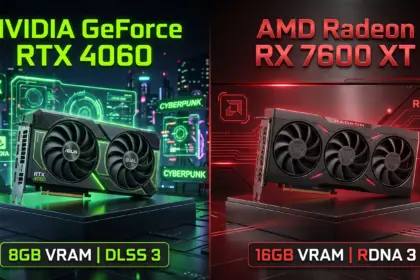
- The Death of Texture Stutters: Modern games increasingly fill 12–16 GB of video buffer at ultra settings in 2K/4K (we discussed this problem in detail in our RTX 4060 vs. RX 7600 XT test). With the transition to the Windows 11 Unified Memory architecture, the amount of available memory will no longer be a bottleneck.
- A Nuance with Bandwidth: Miracles don’t happen—even 256-bit LPDDR5X (270 GB/s) is slower than discrete GDDR6X on top-tier cards (1000+ GB/s). However, due to capacity, the absence of a PCIe bus as an intermediary, and optimized L3 cache, the difference in neural network inference tasks is leveled out.
SoftAndGadget Verdict 🎯
The Windows 11 Unified Memory technology, along with the IntelligentCarveout feature, is not just a cosmetic switch in the settings. It’s Microsoft’s official acknowledgment: the future of personal workstations and mid-range gaming systems lies in high-speed unified memory on a single socket. We are closely monitoring the release of stable builds and will test the actual speed increase as soon as updated AMD and Intel drivers reach the release channel.
Material prepared by the technical editorial team of SoftAndGadget.
For homelabs, remote testing, and staging environments, we run NVMe VDS instances on Erahost. Fast provisioning, European routing, and predictable I/O.
View NVMe Plans →