New software frame generation unexpectedly became available to owners of previous-generation graphics cards, despite all official developer statements. Every time a new line of graphics accelerators is released, users are persistently told that advanced visual algorithms require exclusively new silicon for a substantial sum. However, the enthusiast community has once again proven that many hardware limitations exist only in marketing slides.
According to the authoritative industry portal VideoCardz, independent developers managed to bypass the strict restriction. New frame generation now successfully works on RTX 30 cards.
What the Official Restriction Entailed
Initially, the vendor’s official stance was based on a lack of alternatives: the intermediate image interpolation technology was supposedly physically incapable of working without an updated Optical Flow Accelerator block. This hardware unit is responsible for calculating pixel motion vectors between two adjacent frames in high resolution.
Owners of even top-tier and expensive solutions, such as the RTX 3080, RTX 3080 Ti, and the flagship RTX 3090, were left to content themselves with only basic DLSS Super Resolution upscaling. Any player requests for the implementation of intermediate frames in drivers were rejected with arguments about a fatal drop in image quality, blurred trails, and unacceptable input lag, especially considering the advancements in modern processor architectural blocks.
How Modders Managed to Crack the System
The community pursued deep reverse engineering of the original dynamic link libraries. The modification intercepts graphics API commands and redirects complex mathematical calculations of optical flow vectors to standard Ampere architecture Tensor Cores, which the company’s engineers publicly called ‘unsuitable for this task.’
In essence, the algorithm forces the graphics card to perform auxiliary frame calculation programmatically. This creates an additional computational load on the silicon die, but the raw power of the previous series’ flagships proves more than sufficient to compensate for the costs with a tangible overall framerate increase.
Test Results: Performance and Latency
The first independent measurements in current demanding projects showed astonishing results:
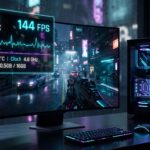
* **Cyberpunk 2077 (1440p, ‘Ultra’ preset):** On an RTX 3080 graphics card without modification, the counter stayed around 55–60 FPS. After implementing the mod and activating the algorithm, the framerate jumped to a stable 85–92 frames per second.
* **Alan Wake 2 and Control:** Projects with heavy geometry and volumetric lighting demonstrated a pure smoothness gain of 45% to 60% without critical texture blurring in motion.
* **Input Lag:** Since the hardware OFA module is absent, system response increases by approximately 8–12 milliseconds compared to native 40-series solutions. However, with NVIDIA Reflex’s low-latency mode simultaneously enabled, control remains comfortable for any single-player story games.
Step-by-Step Installation Guide for the Modification
To activate the technology on their system, enthusiasts will need to perform a few simple steps:
1. Download the modified DLL library package from the project’s GitHub page.
2. Unpack the received files into the root directory containing the executable file of the desired game.
3. Launch the game and enable the frame generation option in the graphics settings.
4. Be sure to set the Reflex parameter to “Enabled + Boost” to mitigate the increased input lag.
Market Logic Versus Common Sense
This precedent clearly confirms a fact that independent authors have been stating for years: the potential of modern computer hardware is deliberately held back by software barriers. Manufacturers need to stimulate sales of new graphics card lines, so the simplest marketing move is to declare last year’s flagships obsolete at the software level.
Nevertheless, as long as an open developer community exists, users find ways to extend the lifespan of excellent equipment. The RTX 30 line remains a powerful workhorse, capable of delivering excellent results in 2026.
This example proves that official frame generation can also work on previous generations of cards.
It is worth noting that such user modifications not only extend the service life of high-performance equipment but also force developers to reconsider their support policies. If older graphics cards technically cope with the computational tasks, open access to innovations becomes the main driver of industry development. Ultimately, players benefit by getting the maximum return from their PCs without the need for annual expensive graphics card upgrades.
In the end, enthusiasts proved that software limitations are surmountable, and RTX 30 graphics cards are capable of delivering high frame rates in modern blockbusters for a long time to come. Excellent result.
Source: The full technical report and links to the modification are published in the specialized material on VideoCardz.com.
For homelabs, remote testing, and staging environments, we run NVMe VDS instances on Erahost. Fast provisioning, European routing, and predictable I/O.
View NVMe Plans →