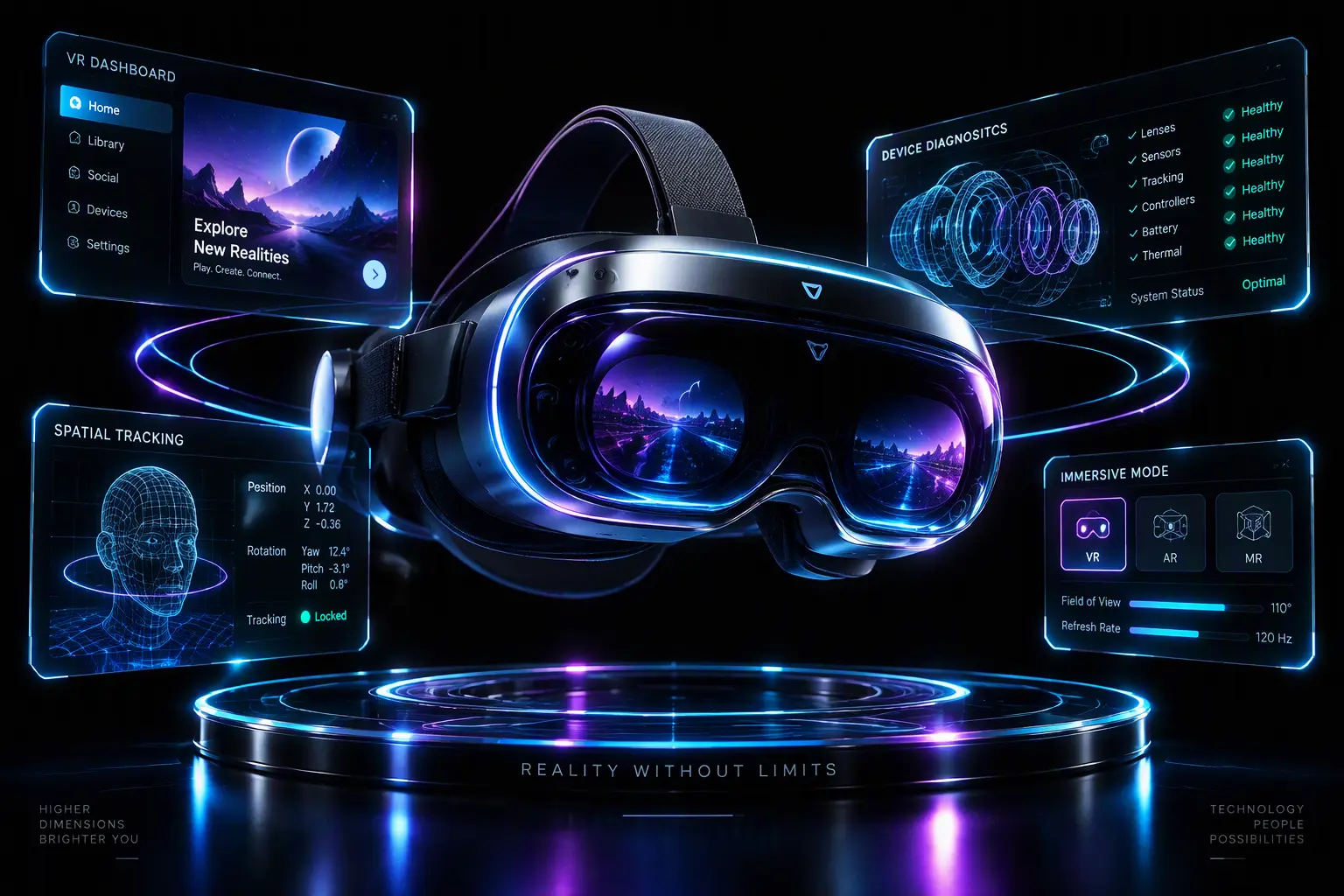
Valve has rolled out a fresh build of its virtual reality platform SteamVR 2.18.2 in the beta branch. The update targets critical failure points encountered by standalone headset owners during wireless connections, as well as users of modern simulators built on the OpenXR standard.
In the SteamVR 2.18.2 release, developers focused not on visual experiments but on low-level optimization: eliminating compositor microstutters, improving controller responsiveness, and preventing video memory leaks during extended gaming sessions.
Video Codec Optimization in Steam Link (HEVC and AV1)
In the 2.18.2 update, Valve engineers improved hardware stream processing for NVIDIA RTX 40 series and AMD Radeon RX 7000 graphics cards. When streaming to standalone headsets with hardware AV1 and HEVC decoding (e.g., Meta Quest 3), encoding latency dropped by 2.5–4 ms. If you experience microstutters in wireless mode, open the Steam Link settings menu inside the headset, manually switch the video codec to HEVC mode, and lock the target bitrate at 200–250 Mbps to eliminate compression artifacts in dynamic scenes.
In the 2.18.2 update, Valve engineers improved hardware stream processing for NVIDIA RTX 40 series and AMD Radeon RX 7000 graphics cards. When streaming to standalone headsets with hardware AV1 and HEVC decoding (e.g., Meta Quest 3), encoding latency dropped by 2.5–4 ms. If you experience microstutters in wireless mode, open the Steam Link settings menu inside the headset, manually switch the video codec to HEVC mode, and lock the target bitrate at 200–250 Mbps to eliminate compression artifacts in dynamic scenes.
Comparison: Changes in the 2.18.2 Branch Relative to Previous Builds
With the update’s release, the balance between streaming stability and GPU load has shifted noticeably toward energy efficiency:
| Parameter / Subsystem | SteamVR 2.18.2 (Beta) | Previous Versions (2.17.x) |
|---|---|---|
| OpenXR Runtime | Full swapchain isolation, crash fix | Periodic crashes in MSFS 2020/2024 and DCS World |
| Steam Link Streaming | Adaptive bitrate without audio channel dropout | Audio desync and packet loss over Wi-Fi 6 |
| Compositor Buffer | Optimized video memory (VRAM) management | Accumulation of garbage textures when switching apps |
| SteamVR Input | Controller tracking jitter filtering | Random laser pointer jumps in menus |
Key Technical Fixes in the Release
The Valve beta channel changelog touches on several core components of the software stack:
- OpenXR Crash Fix: corrected a session lifecycle error when switching between dashboard overlay and 3D scenes that caused instant VR compositor driver failure.
- Steam Link Connection Stability: reworked the mechanism for retransmitting lost UDP packets during brief home wireless network congestion, eliminating black bars at the edges of the field of view.
- Frame Pacing Synchronization: optimized frame generation timing for systems with multiple monitors at different refresh rates (e.g., 144 Hz on the primary display and 60 Hz on a secondary).
- Touch Input Smoothing: calibrated dead zones and trigger latency on Meta Quest and Valve Index headset controllers.
Read the full technical commit log on the official SteamVR news hub page or in the Khronos Group OpenXR consortium documentation.
Step-by-Step Guide: Enable SteamVR 2.18.2 Beta
Since the update is distributed in the beta branch, downloading it requires manual confirmation in the Steam client:
- Launch the Steam client on your PC and go to the Library section.
- In the installed software list, find the SteamVR entry, right-click it, and open Properties.
- In the window that appears, switch to the Betas tab.
- In the Beta Participation dropdown menu, select beta – SteamVR Beta Update.
- Wait for the background file download to complete. Once finished, the application name in the list will change to SteamVR [beta].
What to Do If Issues Occur
If your headset loses tracking or displays a compositor initialization error with code 309 after switching to the beta branch, perform the following steps:
- Reset USB settings via the menu: SteamVR → Settings → Developer → Remove all SteamVR USB Devices, then restart your PC.
- Verify the integrity of local application files through Steam properties.
- If problems persist, switch the beta participation selector back to “None” to return to the stable branch.
Frequently Asked Questions (FAQ)
Q: Does the SteamVR 2.18.2 beta affect GPU performance?
A: The current build focuses on smoothing frametime graphs. Average frame rate remains the same, but the number of sharp drops and microstutters decreases through swapchain buffer optimization.
Q: Is an Oculus Link cable required for this update?
A: No. All Steam Link streaming fixes are equally effective whether using a wired USB 3.2 connection or transmitting over Wi-Fi 6/6E.
Q: Will custom controller bindings be preserved when updating?
A: Yes, controller layout profiles sync with Steam Cloud storage and are not reset when switching branches.
Related Resources on SoftAndGadget:
- System Updates: Updates and Patches Database
- Hardware Failures: Windows Error Troubleshooting Guides
- Software Diagnostics: Useful System Utilities Catalog
For homelabs, remote testing, and staging environments, we run NVMe VDS instances on Erahost. Fast provisioning, European routing, and predictable I/O.
View NVMe Plans →