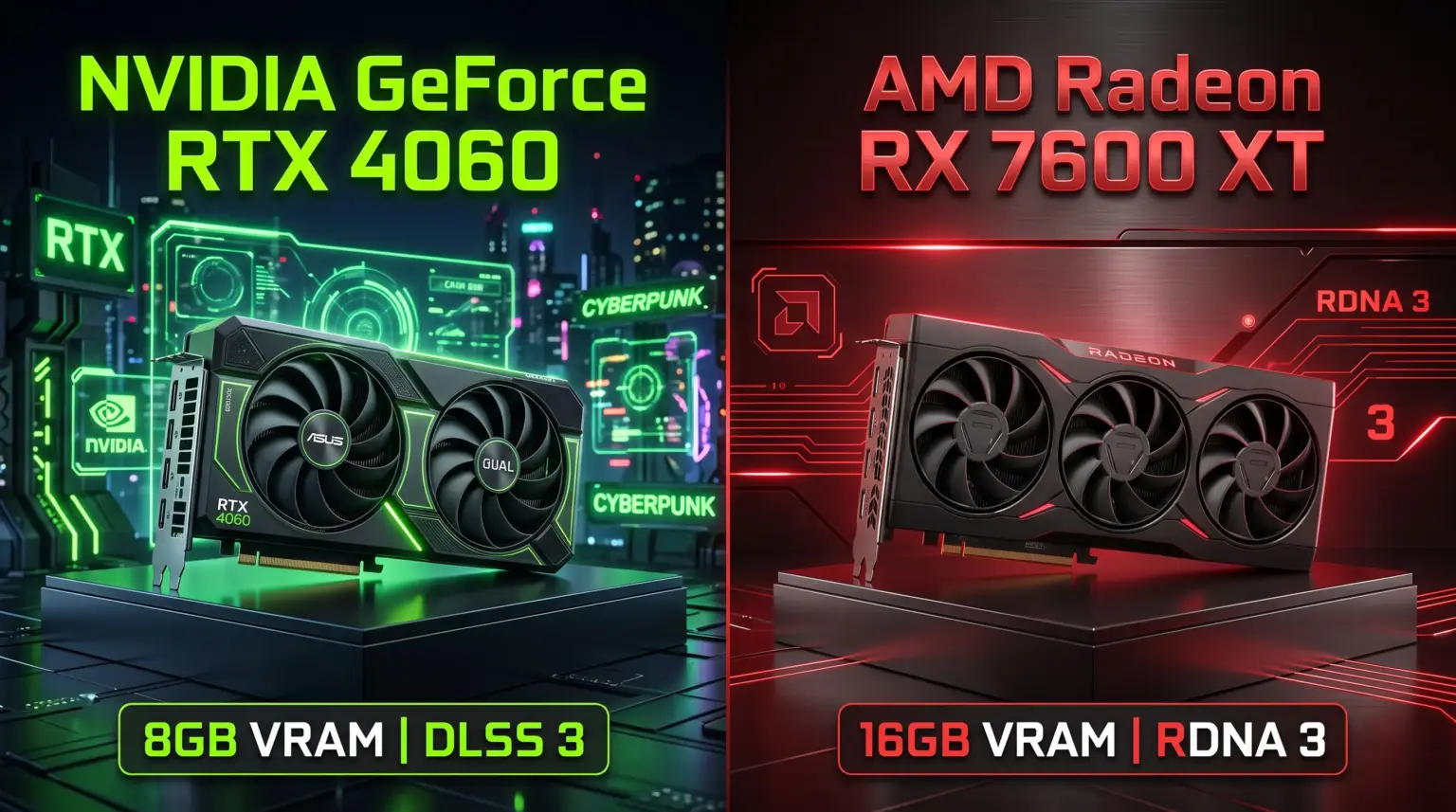
Choosing a mid-range graphics card always involves finding a compromise. In the ‘under $350’ category, the main rivals remain the NVIDIA GeForce RTX 4060 and AMD Radeon RX 7600 XT. Both cards are positioned as ideal solutions for 1080p gaming but play entirely different strengths.
Let’s break down the results of recent consolidated tests and find out whose architecture proves more future-proof.
In this detailed guide, we’ll compare their real-world capabilities, thermal performance, and relevance for modern gaming builds.
- Choosing a mid-range graphics card always involves finding a compromise. In the ‘under $350’ category, the main rivals remain the NVIDIA GeForce RTX 4060 and AMD Radeon RX 7600 XT. Both cards are positioned as ideal solutions for 1080p gaming but play entirely different strengths.
- Let’s break down the results of recent consolidated tests and find out whose architecture proves more future-proof.
- Technical Specifications: Volume vs. Technologies
- Comparative Table of Technical Specifications
- Raw Gaming Performance (Without Upscalers)
- Ray Tracing and Upscaling: NVIDIA’s Dominance
- Conclusion: What to Buy?
Technical Specifications: Volume vs. Technologies
The main visual difference that stands out when analyzing the specifications is the memory subsystem:
-
NVIDIA RTX 4060: comes with only 8 GB of GDDR6 video memory and a narrow 128-bit bus. The situation is saved only by the increased L2 cache (up to 24 MB), which reduces the load on the bus.
-
AMD RX 7600 XT: boasts an impressive 16 GB of GDDR6 on the same 128-bit bus. In terms of memory capacity, AMD has created a buffer for a couple of years ahead.
Comparative Table of Technical Specifications
To clearly assess the differences between the models, let’s compare the key specifications of the graphics processors:
| Parameter | NVIDIA GeForce RTX 4060 | AMD Radeon RX 7600 XT |
| Architecture | Ada Lovelace | RDNA 3 |
| Video Memory Capacity | 8 GB GDDR6 | 16 GB GDDR6 |
| Memory Bus | 128-bit | 128-bit |
| Power Consumption (TDP) | 115 W | 190 W |
| Recommended PSU | 500 W or more | 600 W or more |
| Upscaling Technologies | DLSS 3 (Frame Generation) | FSR 3 (Fluid Motion Frames) |
| Ray Tracing | 3rd Gen RT Cores | 2nd Gen Ray Accelerators |
8 GB vs. 16 GB: How Critical is Memory Capacity?
The main stumbling block when choosing is the VRAM buffer size. The 16 GB on board the RX 7600 XT provides a confident reserve for heavy ultra-quality texture packs in modern projects.
At the same time, the 8 GB of the RTX 4060 is more than enough for the vast majority of 1080p scenarios, especially if your system’s processor effectively unlocks the card’s potential. For a balanced build, a classic 6-core CPU like the Ryzen 5 5600X is an excellent match for the RTX 4060, providing enough power so the graphics card isn’t bottlenecked by CPU performance.
Raw Gaming Performance (Without Upscalers)
In classic rasterization (in games without ray tracing and smart upscaling), the situation is as follows:
-
In games up to 2024: the graphics cards go head-to-head. In hits like Cyberpunk 2077 or Red Dead Redemption 2 at ultra settings in Full HD, the difference between them is no more than 3–5% in favor of one model or the other, depending on engine optimization.
-
In demanding new releases: this is where AMD’s 16 GB of video memory starts to show its teeth. In projects that heavily consume high-resolution textures, the RTX 4060 with its 8 gigabytes starts to hit memory limits, leading to micro-stutters. The RX 7600 XT delivers a more stable framerate graph (0.1% Low).
Ray Tracing and Upscaling: NVIDIA’s Dominance
As soon as modern technologies are activated in the settings, the balance of power changes dramatically:
-
Ray Tracing: Architecturally, NVIDIA’s Ada Lovelace generation RT cores are head and shoulders above AMD’s RDNA 3 solutions. When ‘rays’ are enabled, the RX 7600 XT loses up to half its frames, turning gameplay into a slideshow, while the RTX 4060 maintains playable FPS.
-
DLSS 3.0 vs. FSR 3.0: Frame generation from NVIDIA (DLSS) works based on hardware Tensor Cores. The image is sharp, and artifacts in motion are almost imperceptible. AMD’s FSR technology works at a software level, which often results in noticeable ghosting and texture blurring on the RX 7600 XT during frame generation.
Conclusion: What to Buy?
Both graphics cards excel at their main task—comfortable Full HD gaming—but are aimed at different users:
-
Choose NVIDIA GeForce RTX 4060 if you value cutting-edge technologies: high-quality DLSS 3 upscaling, stable FPS with ray tracing, cool and quiet operation with only 115 W power consumption, and excellent software support for video editing and 3D modeling.
-
Choose AMD Radeon RX 7600 XT if you’re buying a graphics card with an eye on maximum video memory headroom (16 GB) for heavy textures in future games and prefer to play at pure native resolution without ray tracing.
For homelabs, remote testing, and staging environments, we run NVMe VDS instances on Erahost. Fast provisioning, European routing, and predictable I/O.
View NVMe Plans →