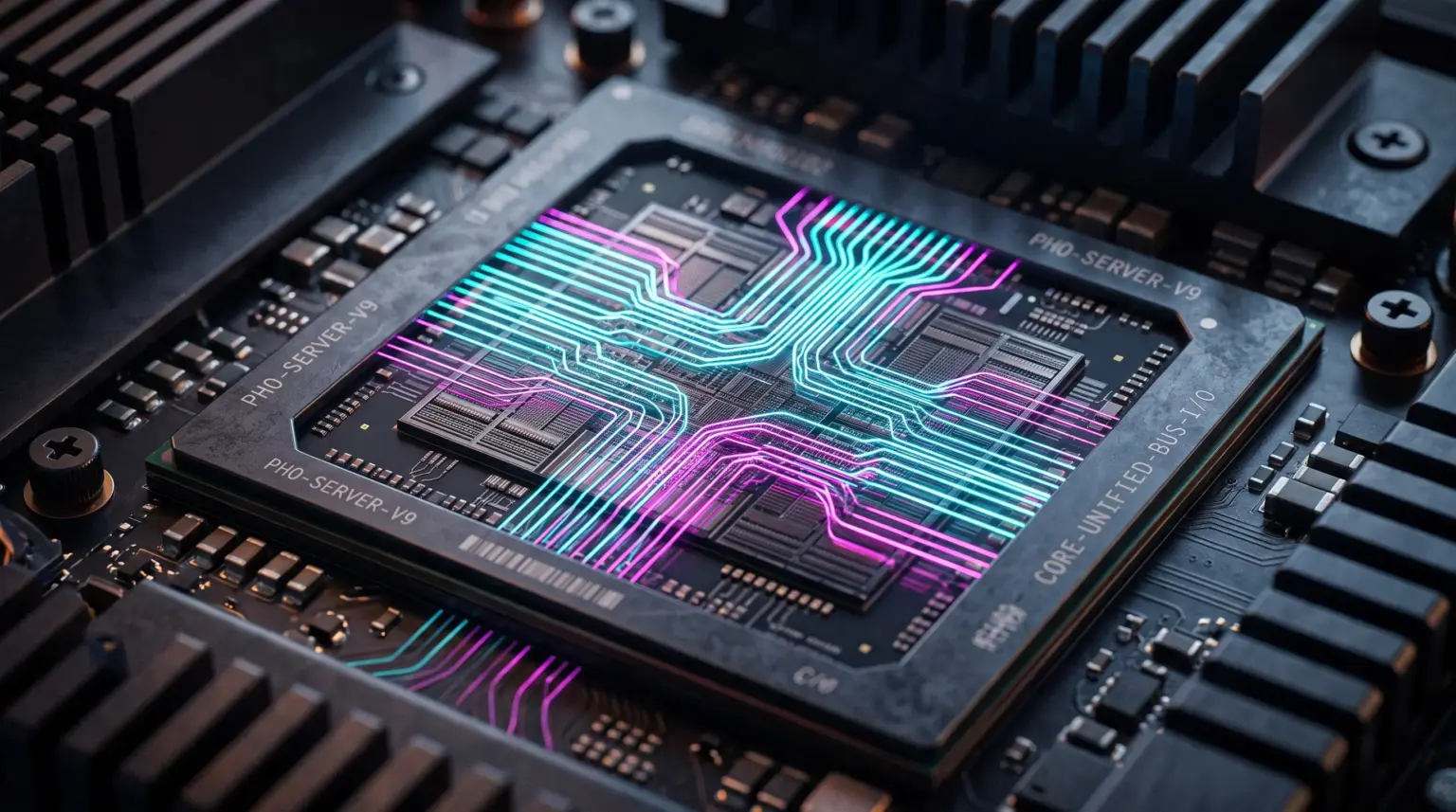
The Huawei Peerium architecture officially breaks the classical paradigm of server computing. For years, data centers scaled extensively: racks were packed with servers, connected via Ethernet or InfiniBand, and hit a physical ceiling of latency. The result is familiar to any system engineer — a data bus bottleneck, RAM fragmentation, and colossal silicon idle time when attempting to synchronize heavy neural network models. This new distributed system completely redefines the topology of computing clusters.
- The Collapse of the Classical Turing Model and Von Neumann Bottlenecks
- UnifiedBus (UB): Silicon Coherence Without Latency
- Comparison of Next-Generation Server Interconnects
- UnifiedBus vs. Compute Express Link (CXL 3.1): The Fundamental Difference
- Software Stack: How Compilers Adapt to Flat Memory
- Power Efficiency and Thermal Design Power: The Cost of a Million Cores
The Collapse of the Classical Turing Model and Von Neumann Bottlenecks
In traditional servers, each node is isolated: its own processor socket, local RAM controller, and a separate operating system instance. When terabyte matrices of modern LLM weights are transferred between nodes, classical protocols burn up to 40% of useful computational power solely on packet serialization, interrupt handling, and remote cache coherence.
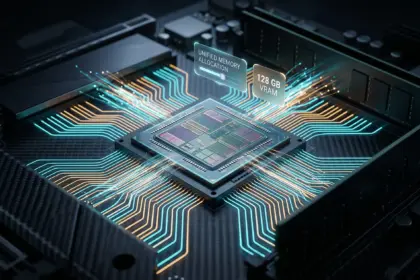
The Huawei Peerium platform eliminates the software-hardware gap between nodes. Instead of combining disparate servers into a network, the architecture assembles silicon dies into a monolithic computing fabric. For software and compilers, such a giant cluster appears not as a fragmented zoo of thousands of virtual machines, but as a single flat address space. Against the backdrop of how modern processor architectures and specialized NPU neural processors in silicon are evolving, this is the biggest shift since the introduction of the first NUMA nodes.
UnifiedBus (UB): Silicon Coherence Without Latency
The core of the platform is a specialized hardware interconnect, UnifiedBus (UB). This is not a standard packet network, but a direct bus with hardware-controlled memory coherence at the inter-die level:
- Direct Memory Addressing (Zero-Copy): Processors exchange data directly through hardware bus controllers, completely bypassing the operating system kernel’s network protocol stack.
- Scaling up to 1,000,000 Chips: UnifiedBus topology is designed to combine up to a million computing dies into a single address pool without bandwidth degradation.
- Hardware Cache Coherence: A processor core in one rack requests data from a chip’s cache at the opposite end of the data center with minimal latency, comparable to inter-core exchange within a monolithic chiplet.
- Fault-Tolerant Routing: Hardware bus switches dynamically reconfigure data packet routes in case of individual die failures without restarting the computational cycle.
The Huawei Peerium concept transforms a data center cluster into a giant virtual die. The boundary between a local L3 cache and the remote memory of an adjacent rack is erased at the hardware level.
Comparison of Next-Generation Server Interconnects
To understand the scale of changes, it is enough to compare the Huawei Peerium architecture with existing high-performance cluster standards:
| Technology | Maximum Scale | Memory Model | Latency Level |
|---|---|---|---|
| InfiniBand NDR | Tens of thousands of nodes | Disaggregated (RDMA) | Microseconds (μs) |
| NVLink Switch | Up to hundreds of GPUs per domain | Coherent GPU memory | Sub-microseconds |
| Huawei UnifiedBus | Up to 1,000,000 dies | Unified flat memory | Hardware nanolevel |
UnifiedBus vs. Compute Express Link (CXL 3.1): The Fundamental Difference
The Western server industry actively promotes the CXL standard, attempting to pool RAM via physical PCIe lanes. However, CXL retains a serious architectural drawback — its dependence on PCIe bus packet serialization, which creates parasitic latency of tens of nanoseconds with every inter-processor access.
Huawei Peerium engineers took a different approach, implementing a hybrid interconnect with silicon photonics elements. UnifiedBus operates not with PCIe module packets, but with direct hardware cache-line transactions. This transforms a server rack into something akin to a single socket, eliminating the need for complex external memory pooling switches.
Software Stack: How Compilers Adapt to Flat Memory
Hardware is dead without software. Low-level compilers and parallel programming frameworks are being rewritten for the Huawei Peerium architecture. In traditional systems, programmers must manually arrange tensors and call inter-process communication primitives like MPI or NCCL. In a cluster with UnifiedBus, the execution environment automatically distributes instruction streams to available computing nodes, eliminating the need for network layers.
Power Efficiency and Thermal Design Power: The Cost of a Million Cores
Scaling a computing fabric to a million dies inevitably runs into the thermal dissipation and power consumption limits of a data center. In the Huawei Peerium architecture, power management is implemented at the hardware level of the interconnect. The UnifiedBus can dynamically redistribute load on the fly, reducing clock frequencies or powering down idle computing clusters to prevent localized overheating of server racks.
The transition to direct liquid cooling (DLC) combined with optical transceivers allows for a 30–35% reduction in energy consumption for data transfer within the cluster compared to traditional copper InfiniBand lines and PCIe extenders.
For the server market and cloud providers, the verdict is clear: the era of brute-force clock speed increases and monstrous monolithic dies is definitively over. The future of high-performance systems now depends entirely on the speed of direct inter-die interconnect buses.
For homelabs, remote testing, and staging environments, we run NVMe VDS instances on Erahost. Fast provisioning, European routing, and predictable I/O.
View NVMe Plans →